
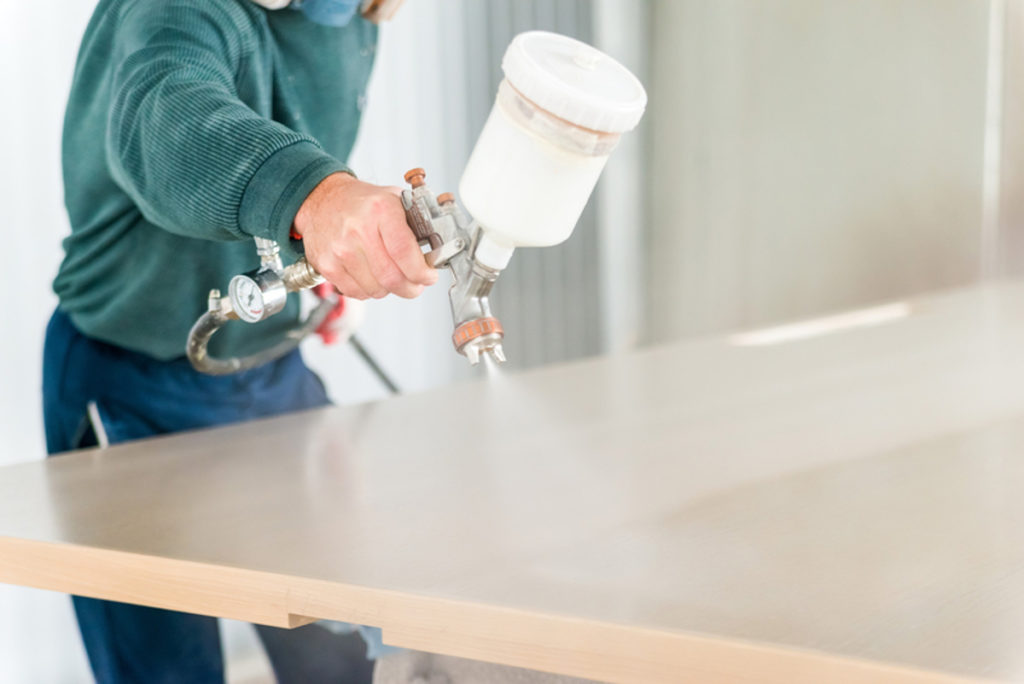
If you’ve ever sought advice on the “best” wood finishing spray system, you’ve probably encountered something like this:
“HVLP is best for fine finishes. Airless is best for speed. Air-Assisted Airless is best for the best of both worlds.”
And then there’s conventional air spray, the old-school technology…that many experienced finishers still swear by.
There’s truth in all of those descriptions, but they’re usually not quite enough to help you make a fully informed decision.
Because if you’re a professional wood finisher or an experienced DIYer, you probably don’t need someone to tell you that “HVLP produces the nicest finish” or that Airless sprays the fastest.
The harder question is:
How do I decide which is the best wood finishing spray system for the majority (or variety) of work I do?
The answer isn’t simply “buy the best equipment you can afford.”
It’s a decision based on five things:
- Can the system properly spray the coatings you use?
- What level of finish quality does your work demand?
- How important is production efficiency to you?
- What does your workspace and workflow look like?
- Will the equipment investment pay for itself?
We’ll look at each of those factors in this post, but it’s helpful to start with the biggest differences between these systems, namely…
What’s Actually Powering the Spray System?
Before comparing spray systems, it helps to understand the fundamental distinctions between how they move and/or atomize the coating.
Different systems accomplish this in fundamentally different ways. Here are the main categories:
HVLP (High Volume, Low Pressure)
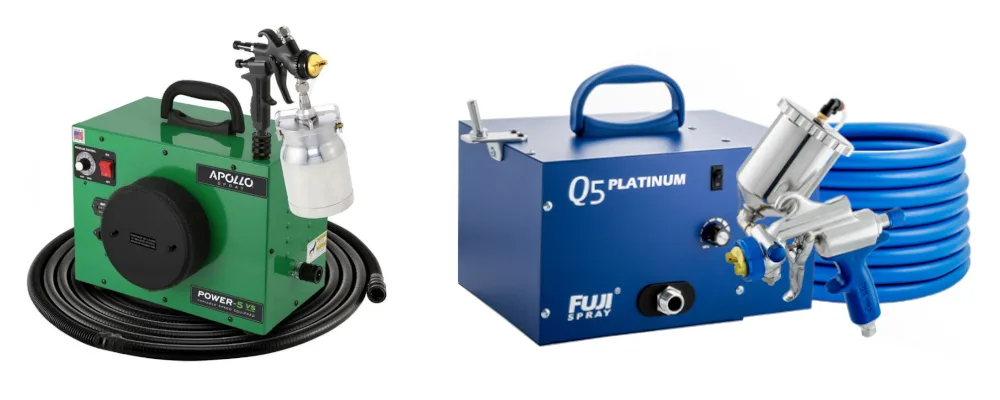
There are two common HVLP configurations:
1. Turbine HVLP
A dedicated electric turbine supplies the air.
It’s self-contained, relatively portable, and particularly popular with furniture makers, cabinetmakers, and serious DIY finishers.
2. Compressor-Driven HVLP
A (high-CFM) air compressor supplies the air to a conversion HVLP gun.
The gun is designed to use a compressor’s air supply while operating at HVLP pressures.
So if someone tells you:
“I swear by my HVLP system.”
There’s one more question worth asking:
“Is it turbine or compressor-driven?”
Both offer the transfer-efficiency advantages of HVLP, but they differ in air requirements, portability, equipment infrastructure and spraying characteristics.
Conventional Air Spray
A compressor supplies relatively high-pressure air to the gun. That air atomizes the coating at the air cap.
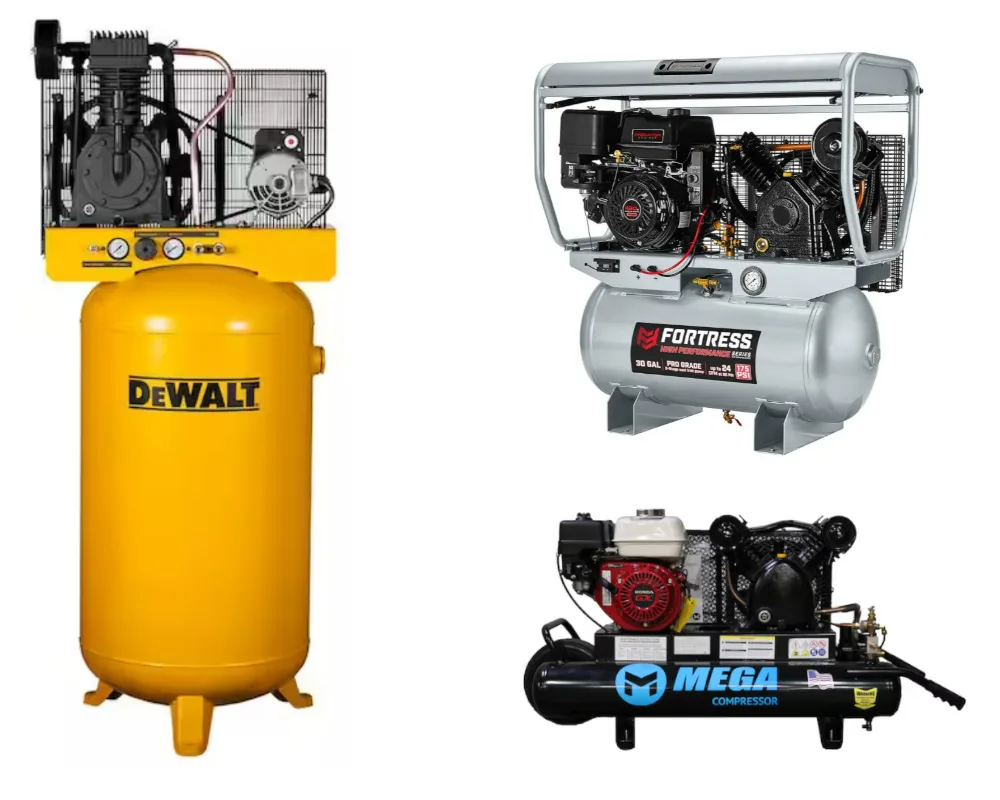
This produces excellent atomization, but also more overspray and lower transfer efficiency than HVLP.
As a result, these systems are prohibited or restricted for commercial use in certain areas of the United States such as Southern California and in certain metro areas such as Houston, Dallas, New York/New Jersey, Chicago and Milwaukee.
Airless
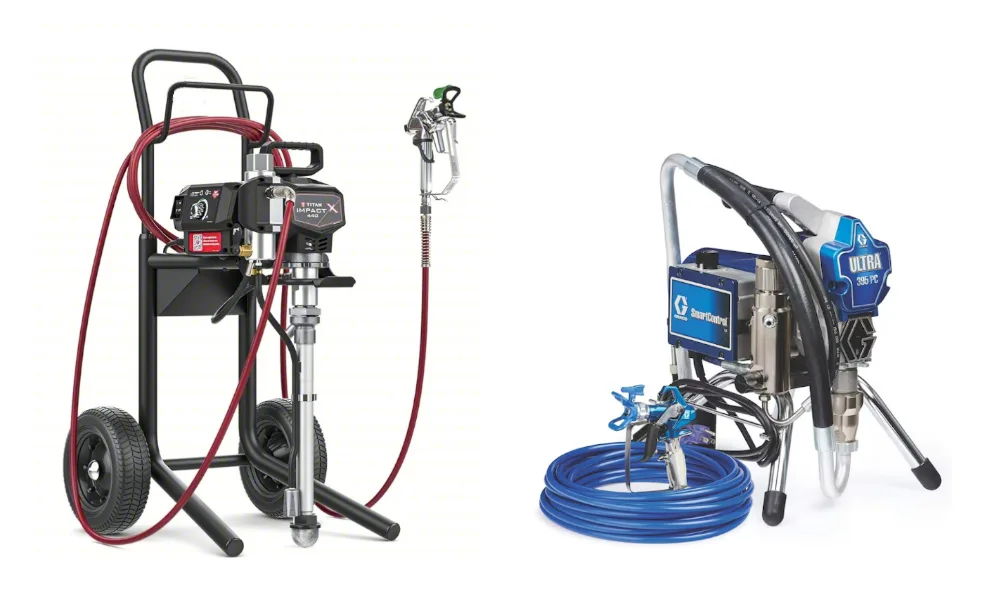
Airless is completely different.
A pump pressurizes the coating (often to thousands of PSI) which is then forced through a tiny tip, and the pressure drop at the tip atomizes the material. No compressed air is used for atomization.
That’s why it’s called airless.
Air-Assisted Airless (AAA)
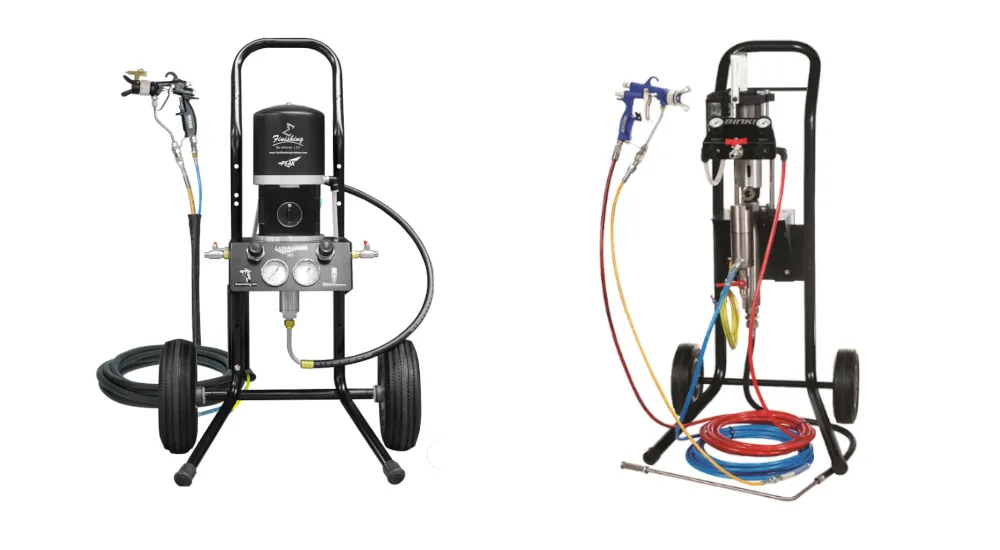
AAA combines the two approaches.
A pump pressurizes the coating, as in Airless. Then, compressed air at the gun further atomizes and shapes the spray.
That’s the basic idea behind the name Air-Assisted Airless.
The Four Systems at a Glance
| System | Powered By | Atomization Method | Pros | Cons |
| HVLP | Turbine or compressor | High-volume, low-pressure air | Control and finish quality | Slower production |
| Conventional | Air compressor | High-pressure air | Fine atomization | Lower transfer efficiency |
| Airless | Motorized fluid pump | High-pressure fluid | Material delivery and production speed | Less atomization control |
| Air-Assisted Airless | Motorized fluid pump + air compressor | High-pressure fluid + compressed air | Production speed + fine atomization | Higher cost and complexity |
That’s the technical foundation.
Now comes the more important question:
How should you decide which spray system is right for the work you do?
In Part 2, we’ll dive deeper into the above five considerations one by one.
PART 2 – The 5 Key Questions to Ask for Finding the Best Wood Finishing Spray System
If the goal of Part 1 was to help you understanding how different wood finishing spray system work, the goal of Part 2 is to understand how YOU work and therefore which system is the best fit.
Here are the key questions to ask:
1. Can the System Properly Spray the Coatings You Use?
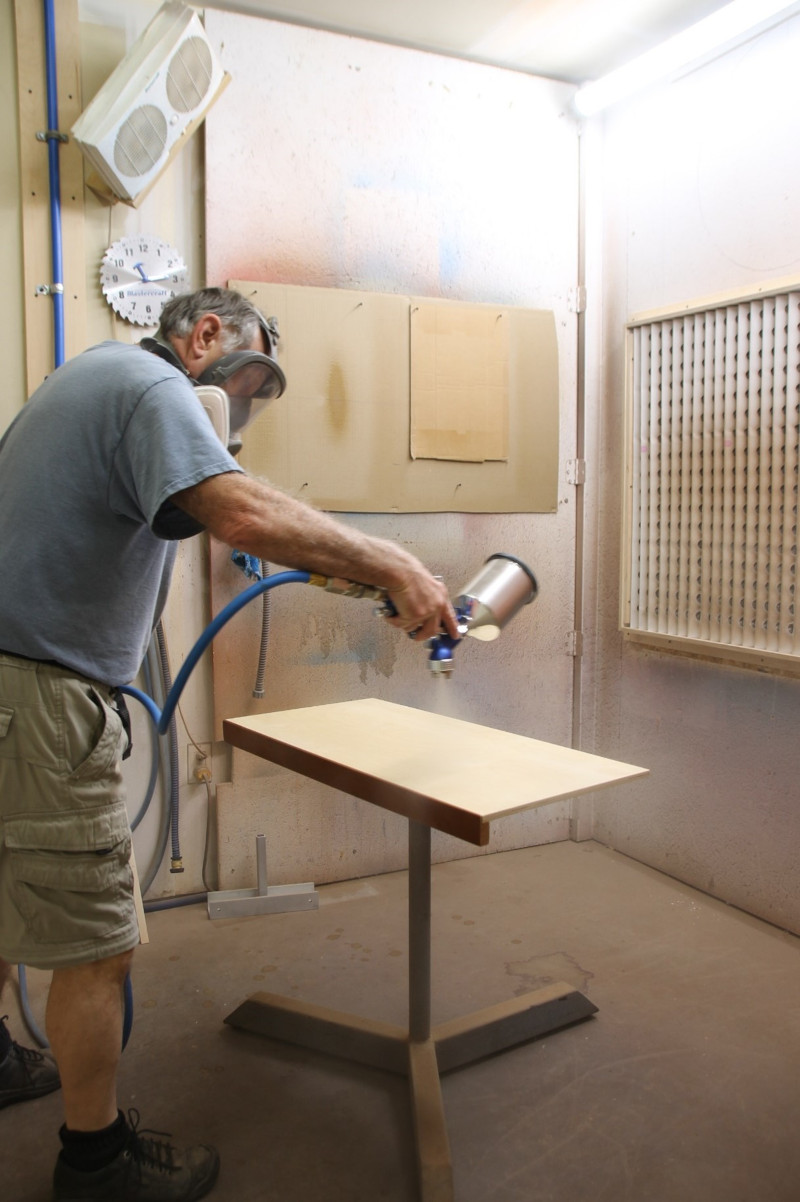
This is often the best question to start with for obvious reasons.
If a spray system can’t properly atomize the coatings you routinely spray, it won’t be very useful.
A thin dye stain and a high-solids waterborne coating behave very differently at the gun. Depending on the coating and equipment, you may need different fluid tips, air caps, pressures, or other adjustments.
And there’s an important reason not to simply assume that “thinning will fix it.”
If you have to significantly reduce a coating just to get it through your equipment, you’re changing the formulation you’re applying to the wood. You may also be putting down less solids per coat.
That’s why experienced finishers pay attention to coating viscosity and the manufacturer’s recommended application equipment.
So, yes, coating compatibility is an important technical “gate,” but it’s not the only thing that drives the final decision on the best wood finishing spray system for your needs.
2. What Level of Finish Quality Does Your Work Demand?
This is where the decision becomes much more personal.
Not every project requires the same level of finish detail and level of control.
For example, if you’re finishing an heirloom dining table (or anything else meant to be touched and admired up close), you’re probably going to prioritize the softest, finest atomization you can achieve, because that’s what determines how level, smooth and “finished” the surface actually looks.
On the other hand, if you’re spraying outdoor fence panels, the equation changes.
That doesn’t mean the fence panels don’t deserve a quality finish.
It means the eye isn’t scrutinizing them the way it scrutinizes a dining table finish, so you might benefit from a system that prioritizes other factors.
3. How Important Is Production Efficiency?
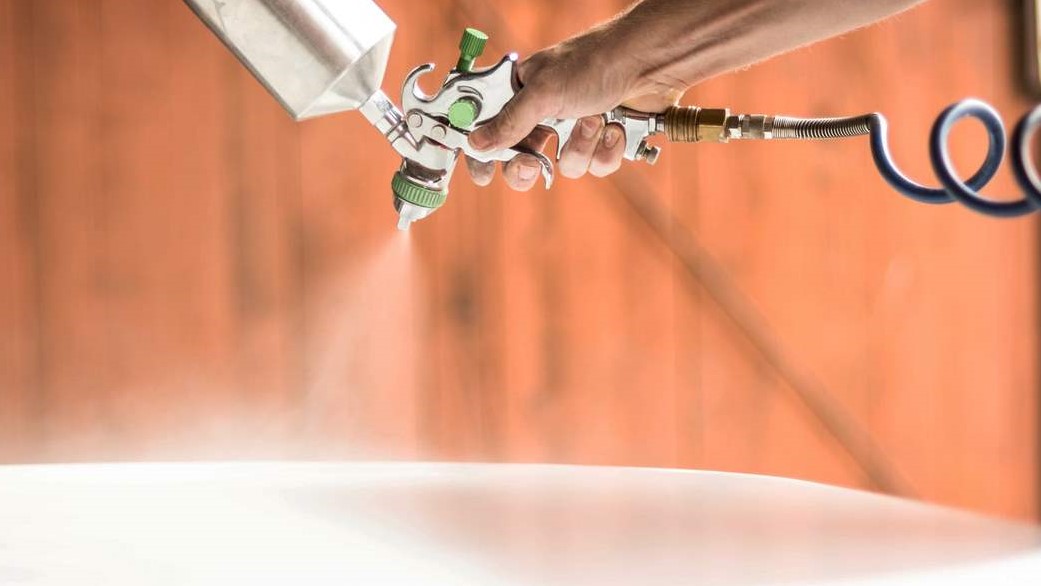
Consider two finishers.
One sprays a renovated bathroom every few weeks.
Another sprays an entire kitchen’s worth of doors, drawer fronts, panels, and boxes every week.
They might use exactly the same coating.
They might demand exactly the same level of finish quality.
But their equipment needs are completely different.
When you’re spraying relatively small quantities, the control and simplicity of an HVLP system can often outweigh the productivity advantages of a larger system.
When you’re spraying gallons of material and dozens (or hundreds) of components, production speed becomes much more important.
That’s when Airless and AAA begin to make a stronger case and why professional finishers often make an equipment change.
They don’t necessarily switch because their existing HVLP system suddenly started producing inferior finishes.
They switch because the system became the bottleneck.
The gun needs to be refilled too often.
The shop is spending too much labor time spraying.
The finishing department can’t keep up with production.
The finisher is spending hours doing something that could be done substantially faster.
Those are very different reasons for switching to Airless or AAA.
4. What Does Your Workspace and Workflow Look Like?

This is the factor most generic equipment comparisons overlook.
Two shops can spray similar types and amounts of finish and still benefit from different equipment.
Why?
Because their workflows are different.
Things to consider:
- How often do you change coatings or colors?
- How much finish do you typically load at once?
- How frequently are you stopping to refill?
- How much hose do you have to manage?
- How much cleanup is involved?
- Are you spraying one-off pieces or batches?
- Are you working in a fixed spray booth or moving around the shop?
- How much of your day is actually spent spraying?
These details matter.
A system that is technically capable of spraying your finish may still be a poor fit if it makes your particular workflow cumbersome.
And by “workflow,” it’s important to consider everything from setup through cleanup. For example, some finishers report Airless cleanup can take up to twice as long as HVLP.
Likewise, where you’re spraying shapes what you can spray with.
For small shops, tight spray booths, or on-site work in someone’s home, overspray control often outweighs the speed advantage of heavier equipment.
Conversely, for larger, well-ventilated production spaces, overspray is often more manageable and speed can take priority.
That’s why experienced finishers sometimes choose equipment that may look excessive on paper.
They’re not necessarily buying more spraying capability, they’re buying a better workflow.
5. Will the Equipment Pay for Itself?
Now we get to price, but I would strongly resist the temptation to look at the cost alone.
Instead, look at the potential benefits, too.
In other words, how quickly will the equipment pay for itself or return value to you?
If you’re spraying a handful of projects a year, spending thousands of dollars on AAA equipment to save a few minutes per project probably doesn’t make much sense.
But If you’re spraying every day, however, saving an hour of labor a day can become a significant annual number.
The same equipment can therefore be a terrible investment for one finisher and an excellent investment for another.
And it’s why “professional” equipment isn’t necessarily the right equipment for every professional.
For example, the right question isn’t:
“Can I afford AAA?”
The right question is: “Will AAA save enough time, material, labor, or frustration to justify the investment?”
That’s a good place to stop for Part 2.
In Part 3, we’ll put everything together into a helpful decision guide.
PART 3 – Making the Final Decision on the Best Wood Finishing Spray System
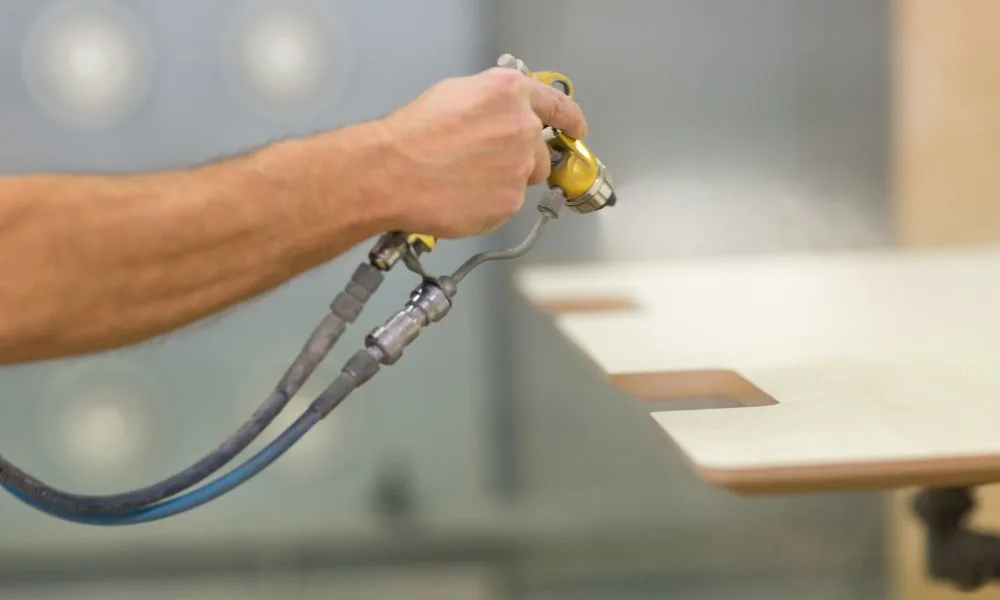
If you read Part 1 and Part 2 of this post, you now have a good idea of how the various types of wood finishing spray systems work…
You’ve had a chance to think about how YOU work (the coatings you spray, your workspace, your workflow, and any other specific finishing requirements)…
So now it’s time to boil everything down into a decision guide.
Here is a helpful way to think about the pros / cons of each system and therefore which one may be the best wood finishing spray system for your work:
HVLP Asks: “How much control can I have over the finish?”
HVLP makes the most sense when you want excellent finish quality and control without needing extreme production speed.
It’s particularly well suited to:
- Custom furniture
- One-off pieces
- High-end cabinetry
- Smaller production runs
- Detail work
- Finishing operations where control matters more than maximum output
For many professional and avid DIY finishers, HVLP is the most versatile single system they can own.
And importantly, you don’t have to be a hobbyist to choose it.
A professional furniture maker who sprays relatively low volumes may have no compelling reason to move beyond HVLP.
Conventional Asks: “How finely can I atomize this finish?”
Conventional air spray remains a legitimate choice for finishers who prioritize very fine atomization or already have a system they know extremely well.
Its biggest disadvantages are lower transfer efficiency and greater overspray compared with HVLP.
If you’re starting from scratch today, there are usually stronger reasons to consider HVLP first.
But if you’re already producing excellent work with conventional equipment, there’s no rule that says you need to change.
If a finisher knows exactly how a particular conventional gun behaves and can consistently produce the finish they want, there may be little incentive to change simply because a newer technology exists.
The important point is this:
Don’t confuse “older” or “less common” with “incapable.”
Conventional spray equipment can still produce exceptional finishes.
Airless Asks: : “How quickly can I get the coating onto the work?”
Airless makes the most sense when your primary challenge is material delivery.
It’s particularly attractive for:
- High-volume production
- Large surfaces
- High-build materials
- Primers and pigmented coatings
- Applications where speed matters more than absolute atomization finesse
For fine clear finishing, an appropriately configured fine-finish airless system can produce very good results.
But a generic airless designed primarily for house paint isn’t necessarily the same tool as a professional fine-finish airless system.
That distinction matters.
AAA asks: “Can I have the best of both worlds – faster application without giving up fine atomization?”
AAA is the system to seriously consider when your work has moved beyond what HVLP can comfortably handle from a production standpoint.
You want:
- Higher material delivery
- Faster application
- Fine atomization
- Professional finish quality
- Better production efficiency
The price is higher.
The equipment is more complex.
But if you’re spraying enough volume, those disadvantages can become irrelevant because the system is solving a much more expensive problem: labor and throughput.
If You Could Own Only One Wood Finishing Spray System
Here’s where the answer gets interesting.
There isn’t one correct answer.
If you’re a professional furniture maker who sprays relatively small volumes, HVLP may be the smartest choice.
If you’re running a production cabinet shop where finishing speed is a major bottleneck, AAA may be the smarter investment.
If you’re primarily concerned with moving large quantities of material quickly, Airless may win.
If you already own conventional equipment and consistently produce the finish quality you want, there may be no compelling reason to replace it.
The mistake is assuming that moving “up” from one technology to another automatically means you’re becoming a more serious finisher.
As I hope I’ve made clear, You’re not upgrading. You’re changing the tradeoffs.
The Quick Decision Guide
The next time you’re considering a spray-system purchase, don’t start by asking which system is “best.”
Instead, start here:
1. Can it properly spray the coatings I use?
If not, stop there.
2. What level of finish quality does my work require?
Don’t pay for production capability you don’t need, and don’t sacrifice finish quality you can’t afford to lose.
3. How important is production efficiency?
Consider a faster spray system if your current one is the bottleneck. On the flip side, buying production-grade equipment for a low-volume operation can be overkill that adds unnecessary cost and complexity.
4. What workspace or workflow constraints do I have?
Consider where and how you do the majority of your work, from setup to cleanup.
5. Will the investment pay me back?
Consider labor, material usage, throughput, cleanup, convenience, and the value of your time, not just the purchase price.
The Bottom Line
Choosing between HVLP, Conventional, Airless, and AAA isn’t really a contest between technologies.
Again, it’s a decision about tradeoffs.
HVLP gives you high finish quality and control…but lacks speed.
Conventional gives you exceptional atomization…but with greater overspray and lower transfer efficiency.
Airless gives you material delivery and speed…but less atomization control.
AAA attempts to give you production speed while retaining the fine atomization needed for professional finishing…but it can be complex and costly.
So, none of those is inherently “better” than the others.
The right question is:
Which combination of finish quality, productivity, workflow, and economics best matches the work I actually do?
That’s the question that experienced finishers answer before they buy the equipment.
And it’s the question that will lead you to the right spray system.
What type of spray system do you use…and do you use different systems based on the project you’re working on?
Please share your thoughts or read what others are saying in the comments section below.
Jeff Weiss is the owner and chief chemist at Target Coatings, which has been dedicated to exclusively manufacturing water-based, low-VOC and HAPs-free wood finishes for nearly 40 years. Creator of the first water-based lacquer with 100% burn-in rivaling nitrocellulose lacquer, Jeff is considered one of the “founding fathers” of water-based technology and safety for refusing to accept the “status quo” and for refusing to expose others to chemicals he wouldn’t want to be exposed to. A U.S. Air Force veteran and former volunteer EMT, Jeff has always put service and safety first. Outside of work, Jeff is an avid fly fisherman who enjoys being immersed in and inspired by Earth’s natural beauty.
As a home hobbiest I found air compressor powered LVLP is a sweet spot of affordable equipment and great finish. The compressor used can be a lower CFM model that doesn’t take up the whole shop and the LVLP guns are not very expensive. The 1.7-2.0 mm caps are capable to spray most modern waterborne wood finishes.
Dave –
Thank you for your reply and insight. Keep in mind that the viscosity of the WB in use may require a smaller tip/cap set.
We recommend between a 1.3mm to a 1.7mm based on the various clear coats we manufacture, and 1.8mm to 2.0mm for our primers and pigmented color finishes.
Keep up the good work!
-JeffW-
I have a conventional compressor and a hvlp conversion gun and a conventional door jamb gun, I have tried both with Target EM6000. I would like to have a turbine hvlp system, but haven’t prioritized it yet. I am a hobby guitar builder and hobby furniture maker. Increasingly I am doing hand tool work and hand finishing (oil or oil varnish or shellac / French polish) because it is quieter and not as messy. But I like waterborne lacquer on the sides and back and neck of the guitar for durability.
Larry-
Thank you for sharing your spray gun setup’s with us!
-JeffW-
I’d love to see you address LVLP. After using HVLP for years, I recently used it to apply Target finishes to a set of cabinets and was impressed that the finish quality seemed as good as what I had been getting with HVLP, but the compressor wasn’t as taxed.
John –
Thank you for your reply.
We’ll focus on LVLP in an upcoming post. Keep up the good work!
-JeffW-
What are most luthiers using?
Steve-
That is a BIG question, because luthiers definitely have their own favorites.
My experience is that most of my luthier customers use LVLP spray guns with the 3M-PPS cup system, running off of various-sized compressors.
-JeffW-