
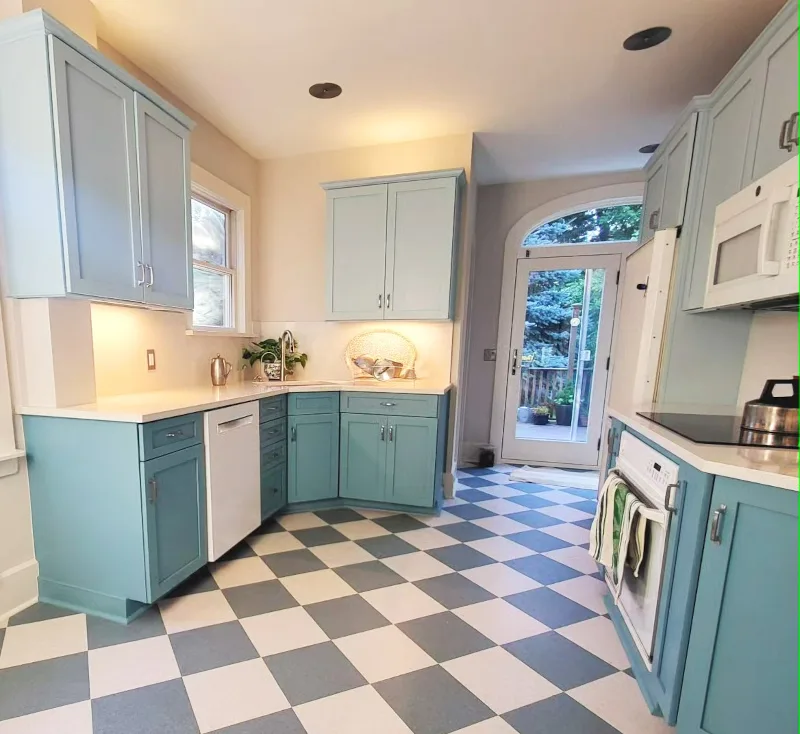
Whether you are a seasoned professional or a dedicated DIY finisher, achieving a flawless kitchen cabinet finish requires more than just the right spray equipment.
Kitchen cabinetry—and other interior woodwork—faces daily exposure to heat, moisture, grease, and frequent cleaning. Choosing the right finishing system is critical to ensuring both beauty and durability.
In the following guide, we’ll look at common compatibility issues, explain potential finish failure modes, and then highlight how EMTECH EM6500 Pigmented Lacquer Series can be used to deliver consistent, long-lasting results.
Controlling Tannin & Sap Bleed Through
The problem: Woods such as oak, pine, and some maples often release tannins or sap that migrate upward and discolor the finish, showing as yellow, brown, or red stains.
Solution with EM6500:
- Begin with a stain-blocking primer—shellac-based or low-pH acrylic—to neutralize acids and block sap migration.
- Thin primer coats properly (up to 40–50%, per manufacturer guidance) to avoid mud-cracking, micro-checking, or surface stress.
- Apply EM6500 pigmented lacquer in thin, even coats at 2-3mils wet per coat. If tinting, note that colorants can slightly alter dry time and flexibility.
- Always allow recommended dry times before recoating to prevent pinholes or poor film formation.
Pro Tip: Prepare and test sample panels of your actual wood species to anticipate bleed behavior and adjust your primer or surfacer selection accordingly.
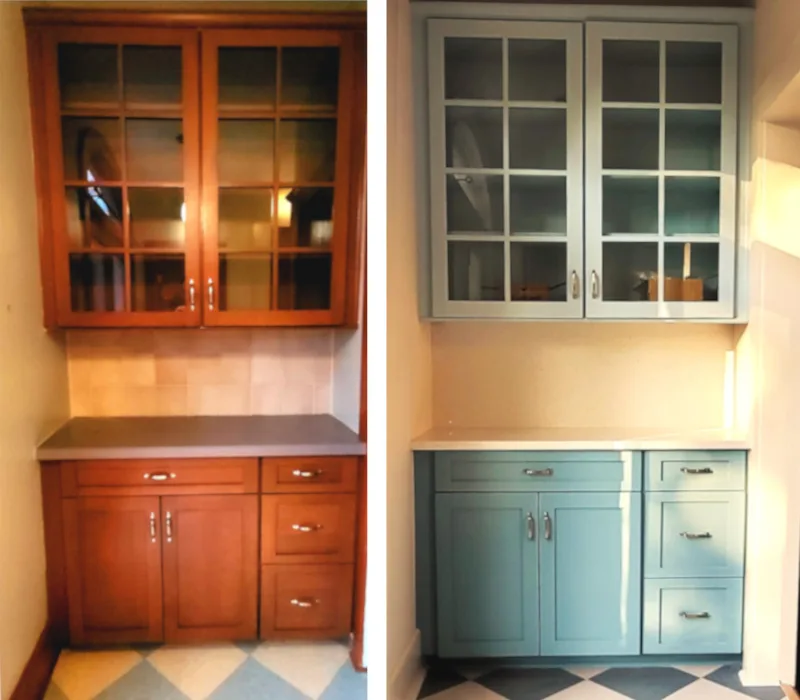
Preventing Grain Telegraphing
The problem: Even after priming, open-grain woods (oak, birch, poplar) or engineered panels (MDF, veneered plywood) may show surface texture through the kitchen cabinet finish.
Solution with EM6500:
- Apply HSF5000 Primer / Surfacer & Grain Filler for a smooth, level substrate.
- Use two controlled coats rather than one heavy pass; monitor wet film thickness (per TDS) to avoid cracking.
- Sand between coats with 320 grit, then clean thoroughly before applying EM6500.
- Finish with 2–4 coats of EM6500, sanding lightly (400 grit) between layers for optimal adhesion and surface refinement.
Troubleshooting Common Failure Modes
| Failure Mode | Likely Causes | Prevention & Fix with EM6500 |
| Mud-cracking or checking | Overly thick primer/surfacer coats; shellac in too high solids content; rapid solvent flash | Thin primers appropriately, apply controlled wet film thickness, and allow proper flash times |
| Micro-checking | Thin topcoat passes; excessive atomization; incompatible undercoats | Apply proper film build, adjust spray gun pressure, and ensure undercoats are chemically compatible. |
| Poor adhesion on existing finishes | Inadequate cleaning/sanding; old finish not conditioned | Clean thoroughly with 1:1 water/alcohol solution, scuff with 400 grit, and consider a bonding primer before EM6500 |
| Tannin or sap migration | Inadequate primer/sealer layers; high moisture exposure | Use proper stain-blocking primer, seal all surfacer layers, and maintain correct application environment |
Sheen & Finish Options
EM6500 is manufactured in a satin sheen, making it ideal for cabinetry and furniture with a modern, refined look. For projects requiring higher gloss:
- Apply a compatible clear water-based lacquer such as EM7000HBL, or a urethane topcoat like our EM9300 Polycarbonate Urethane, over fully cured EM6500.
- Scuff sand lightly before clear coating to ensure adhesion.
Durability & Crosslinking
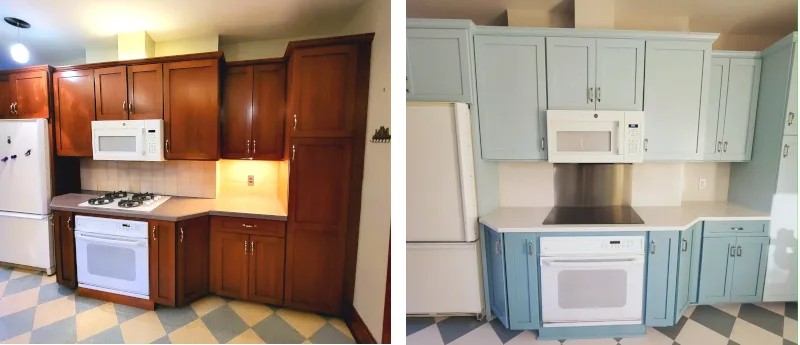
For cabinetry exposed to heavy cleaning and daily wear, EM6500 can be fortified with CL100 Crosslinker (3-5% by volume). This optional additive increases chemical and moisture resistance, enhancing long-term durability against soaps, alcohol, and alkaline cleaners commonly used in kitchens.
Maintenance & Longevity
Finished cabinets should be cleaned with mild, neutral pH, non-abrasive cleaners. Avoid harsh solvents or scouring pads. When properly applied and maintained, EM6500 finishes retain their appearance and integrity for years, rivaling or exceeding solvent-based lacquers in performance.
In Summary…
The path to a flawless kitchen cabinet finish requires more than just a good spray technique. Substrate preparation, the right primer or surfacer, and precise application of EMTECH EM6500 all work together to deliver long-lasting, professional-grade results.
With proper use, EM6500 prevents bleed-through, eliminates grain telegraphing, and provides a durable, environmentally responsible finish that stands up to real kitchen conditions.
Ready to start your next cabinet project? Contact us to discuss your wood species, project requirements, and finish goals — we’ll help you build the ideal finishing schedule with the EMTECH EM6500 Pigmented Lacquer Series.
Have general questions about or comments about your experience using EM6500? Please share your thoughts or read what others are saying in the comments section below.
What happens if the clear coat goes on in 24 hours after the 6500.
George,
Applying a clear coat such as our EM9300 Polycarbonate Urethane after the 24 hour mark is of no consequence.
The adhesion characteristics of the EM9300, and EM7000HBL, are excellent, and they will bond to the semi-cured EM6500 with no issues.
-JeffW-
How long is the cure time for the 6500? Does it depend on the temperature/humidity in the shop?
Alex,
The average full-cure time for EM6500 in pastel colors is 125-200 hours, depending on the number of coats, wet film thickness during application, and ambient conditions.
-JeffW-
Should I be concerned with tannin bleed through using poplar and birch? Thank you
Tim,
While not prone to excessive tannin bleed, poplar and birch may show a low degree of staining if a primer is not applied. Our HSF5000 Primer will block poplar and birch tannins without any issues. Ensure that you apply two thin coats of HSF5000 Primer, sanding between each coat with 400-grit paper. As always, make a test panel to confirm your applications prior to moving on to the actual parts.
-JeffW-